 Refrigerator Repair
 Dishwasher Repair
 Washer Repair
 Dryer Repair
 Oven Repair
 Stove/Cooktop Repair
 Freezer Repair
 Appliance Installation
 Samsung
 Bosch
Bosch
 Thermador
 Miele
Miele
 Sub Zero
 Bloomberg
 Asko
Asko













Monogram Appliance Repair Services
Your Local Monogram Appliance Repair Company
- Monogram F3/F4 oven RTD temperature sensor fault
- Monogram column refrigerator dual-compressor failure
- Monogram Professional range brass burner won’t ignite
- Monogram Advantium speed oven magnetron/halogen fault
- Monogram ZDT dishwasher Piranha disposer jam
- Monogram induction cooktop pan-presence sensor error
- Monogram WiFi Connect loses connectivity
- Monogram wine reserve temperature drift
- Monogram reversible griddle burner heating unevenly
- Monogram F2 oven over-temperature shutdown

Article Reviewed & Technically Verified by Dmitry V., Lead EPA-Certified Technician (15+ Years Experience)
Monogram is GE Appliances’ luxury built-in line — column refrigerators, Professional dual-fuel ranges, Advantium speed ovens, and ZDT dishwashers. Because they share the GE control platform, most run standard F-series fault codes and RTD sensors. We provide same-day Monogram repair across Brooklyn, diagnosing the actual component rather than swapping boards.
Our Happy Customers

- 15+ Years Experience
- Warranty on Parts & Labour
- 100% client satisfaction
- Skilled Technicians
Our Monogram Appliance Repair Services
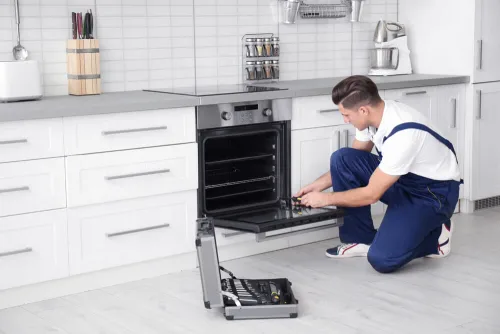
Monogram Range & Stove Repair
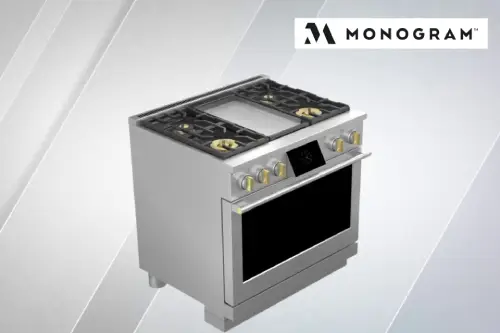
Monogram Professional and Statement ranges use brass dual-flame stacked burners that both simmer low and sear at high BTU from one head. When one won’t light, the fault is usually a fouled spark electrode, a cracked igniter ceramic, or a clogged brass port — not the whole burner. On dual-fuel models like the ZDP486NDTSS and ZDP364NDTSS the electric oven adds an RTD sensor and relay board to the mix.
We diagnose ignition by watching the spark at each electrode and checking spark-module output, then confirm gas flow at the valve. For the oven cavity, we read the RTD resistance (roughly 1,080Ω at room temperature) before touching the control. The reversible cast-iron griddle burner is verified for even flame across its length.
Common issues we fix:
- Brass burner clicks but won’t ignite
- Simmer flame too high or blows out
- Oven underbakes or overbakes
- Griddle heats unevenly end to end
- F-series fault code on the display
- Convection fan not running
- Oven won’t reach set temperature
- Control panel unresponsive or dark
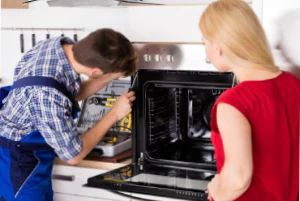
Monogram Wall Oven Repair
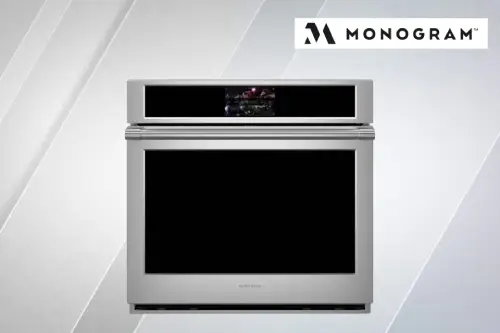
Monogram wall ovens — the ZET1PHSS single and French-door ZET1FHSS — run True European convection with a rear element and fan, plus a temperature probe for roasting. Uneven browning is usually a failed convection element or a stalled fan motor, while off-temperature baking traces back to the RTD sensor or a control relay welded closed.
Our diagnostic logic is measurement-first: we read RTD resistance cold, then watch it climb as the cavity heats to confirm the sensor tracks correctly. If resistance is open or shorted the board throws an F3 or F4, and we replace the sensor rather than the far more expensive control. Door latch and self-clean lock faults are tested at the latch motor directly.
Common issues we fix:
- Bakes too hot or too cold
- Convection fan silent or noisy
- Temperature probe reads wrong
- Self-clean won’t unlock
- F3 / F4 sensor codes
- Oven shuts off mid-bake
- Broil element not glowing
- Display frozen or blank
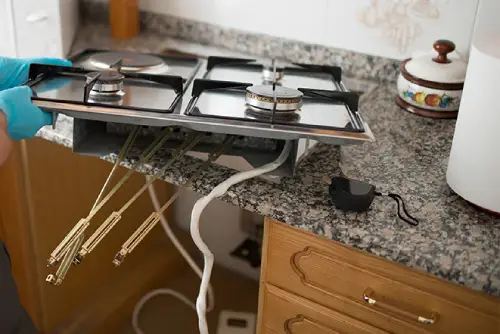
Monogram Cooktop Repair
Monogram induction cooktops such as the ZHU36RSTSS use a pan-presence sensor and internal coil-cooling fan on every one of their five elements. When an element won’t heat, the most common cause is not a dead coil but a pan the sensor rejects, a tripped over-temperature limit on the cooling circuit, or a cracked glass sensing the fault. Gas and electric cooktop variants have their own igniter and element paths.
We test induction by confirming the element energizes only with ferrous cookware present, then verify the cooling fan spins and the thermal cutout hasn’t opened. Glide-touch controls that ignore input are checked at the touch board ribbon before any part is condemned.
Common issues we fix:
- Element won’t detect cookware
- Induction zone cuts out when hot
- Glide-touch controls unresponsive
- Cooling fan loud or seized
- Gas burner igniter keeps clicking
- Cracked glass (assessment and options)
- Element stuck on one power level
- Control-lock won’t clear
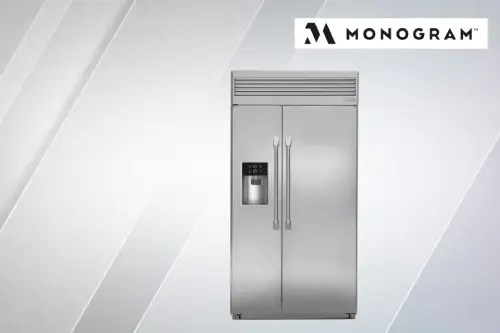
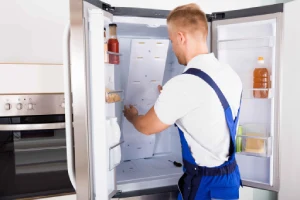
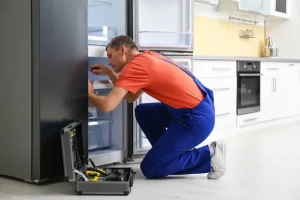
Monogram Refrigerator Repair
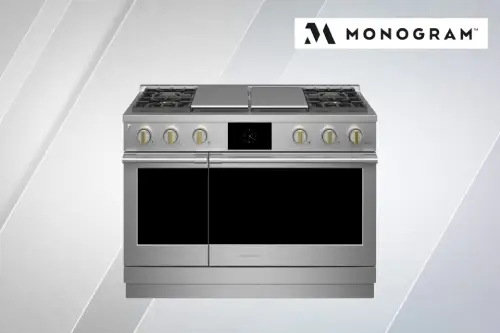
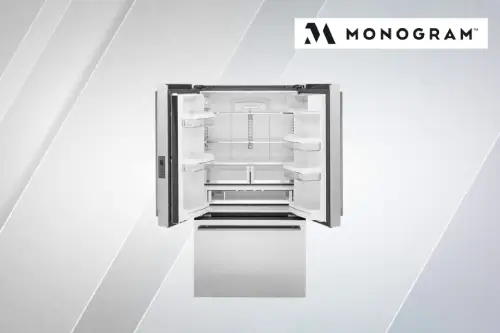
Monogram built-in refrigerators come in two very different cooling architectures: single-compressor side-by-sides like the ZISS420NNSS, and column units (ZIC/ZIF) that pair independent compressors and evaporators for the fresh-food and freezer sides. Knowing which system is in front of us decides the whole diagnosis — a warm fresh-food column with a perfectly cold freezer points straight at that side’s own sealed system or evaporator fan.
We map the failure to the architecture before pulling refrigerant into the picture, per GE’s own Monogram cooling-system service documentation. Any sealed-system work is handled under EPA Section 608 with proper recovery. Frost patterns on the evaporator, fan current, and defrost heater continuity tell us whether it’s airflow or the sealed system.
Common issues we fix:
- One compartment warm, the other cold
- Built-in runs constantly
- Frost buildup on rear evaporator
- Ice maker not producing
- Water dispenser weak or dripping
- Fan or compressor noise
- Door alarm or gasket not sealing
- WiFi Connect offline, temperature drift
Monogram Freezer & Column Repair
Monogram freezer columns and the freezer half of a built-in freezer rely on a dedicated evaporator and defrost cycle. When a column freezer holds poorly while running nonstop, the usual culprit is a defrost heater or defrost thermostat that has stopped clearing the evaporator, choking airflow with ice. The wine reserve units share the same electronic temperature control and can drift for the same reasons.
We confirm defrost failures by checking heater continuity and thermostat closure at temperature, then verify the evaporator fan moves air once the ice is cleared. On independent-compressor columns we isolate whether the fault is the defrost circuit or that side’s sealed system before quoting.
Common issues we fix:
- Freezer column not holding temperature
- Heavy ice sheeting on evaporator
- Runs constantly, poor freezing
- Wine reserve temperature drift
- Fan buzzing or clicking
- Defrost water pooling
- Door not sealing on tall column
- Temperature alarm or sensor fault
Monogram Dishwasher Repair
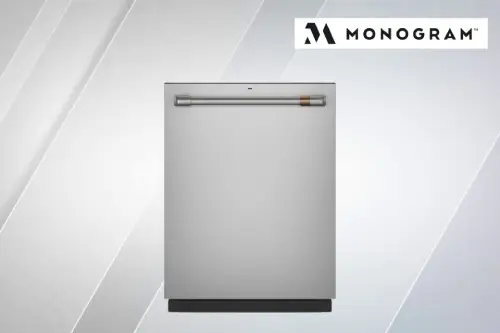
Monogram fully integrated dishwashers like the ZDT915SSJSS run at 42 dBA and use a Piranha hard-food disposer with a stainless blade instead of a manual filter. When dishes come out gritty or the unit won’t drain, the disposer or drain pump is usually jammed with debris, or the check valve is stuck — problems that stay hidden because the machine is so quiet.
We test the drain pump and disposer motor for continuity and free rotation, clear the sump, and confirm the bottle jets and upper-rack spray deliver full pressure. Fill and heat faults are checked at the inlet valve and heater circuit before any board is suspected.
Common issues we fix:
- Standing water, won’t drain
- Piranha disposer jammed or noisy
- Dishes gritty or filmy
- Leaks from door or sump
- Won’t fill or fills slowly
- Poor drying, no heat
- Bottle jets or spray arms weak
- Cycle stalls, control lights blink
Common Monogram Error Codes
Monogram shares the GE Appliances control platform, so its ranges and wall ovens display the same F-series fault codes used across the GE lineup. These codes let us diagnose the failure before arriving and carry the right sensor or latch on the truck. Have the code ready when you call for the fastest estimate.

Monogram Range & Oven Fault Codes
| Code | Meaning |
|---|---|
| F0 | Stuck or shorted keypad / membrane switch |
| F1 | Control (ERC) or RTD sensor fault — runaway heating |
| F2 | Oven over-temperature (sensor or stuck relay) |
| F3 | Open oven temperature sensor (RTD) circuit |
| F4 | Shorted oven temperature sensor (RTD) |
| F7 | Stuck function / touch key |
| F9 | Door latch / lock motor failure |
The RTD oven sensor behind these codes reads about 1,080Ω at room temperature. On an F3 or F4 we confirm the reading at the sensor plug before replacing it — an open or shorted probe is far cheaper to fix than the control board the codes can be mistaken for. Advantium speed ovens (ZSC/ZSB) and dishwashers use their own diagnostics, which we read on site rather than guess.
Technician Case Studies — Monogram Repairs

Diagnostic & Resolution: Read RTD oven sensor at the plug — open circuit (no continuity, spec ~1,080Ω). Replaced the oven temperature sensor, re-checked resistance cold and as it climbed with heat, and verified bake held within ±10°F of 350°F on a calibrated thermocouple.
Diagnostic & Resolution: Found the fresh-food evaporator fan drawing no current and iced over from a defrost-heater failure. Confirmed heater open on continuity, replaced heater and defrost thermostat, cleared the ice, and airflow restored the compartment to 37°F overnight.
Diagnostic & Resolution: Piranha hard-food disposer seized on a shard of glass; drain pump could not clear the sump. Cleared the disposer, tested pump motor for free rotation and continuity, flushed the check valve. Full drain confirmed in under 60 seconds across two cycles.
Diagnostic & Resolution: Element energized correctly with a known ferrous test pan, isolating the fault to a tripped over-temperature limit on the coil-cooling circuit — cooling fan had seized with dust. Replaced the fan, cleared the thermal cutout, and all five zones held full power output.
Diagnostic & Resolution: Isolated the loss to the halogen speedcook lamps — one upper lamp open, so the unit fell back to convection-only heating. Verified lamp continuity, replaced the failed lamp and socket, and confirmed a Speedcook test cook browned evenly.
Diagnostic & Resolution: RTD sensor read in spec, pointing at a bake relay welded closed on the control — element stayed powered past setpoint. Replaced the control relay board, verified the element cut out on command, and confirmed setpoint accuracy with a thermocouple before returning the oven to service.
Frequently Asked Questions — Monogram Appliance Repair
How do you diagnose a Monogram column refrigerator that’s warm on one side?
What does an F3 or F4 code mean on my Monogram range?
Which Monogram appliances do you repair?
Why won’t one brass burner on my Professional range light?
How much does Monogram appliance repair cost?
Address
Brooklyn, NY 11238
Manhattan, Staten Island
Appliance Repair
Payment Options