
 Refrigerator Repair
 Dishwasher Repair
 Washer Repair
 Dryer Repair
 Oven Repair
 Stove/Cooktop Repair
 Freezer Repair
 Appliance Installation
 Samsung
 Bosch
Bosch
 Thermador
 Miele
Miele
 Sub Zero
 Bloomberg
 Asko
Asko














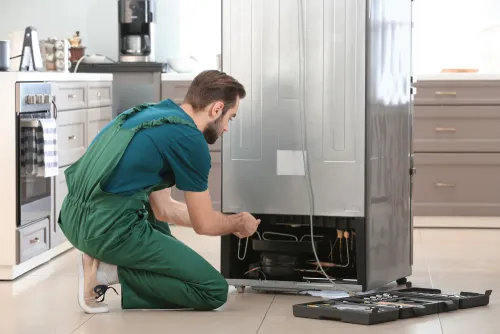
Hisense Appliance Repair Services
Your Local Hisense Appliance Repair Company
- Hisense refrigerator not cooling
- Hisense fridge E0 sensor error code
- Hisense freezer excessive frost / defrost fault
- Hisense washer E1 fill fault
- Hisense washer E2 drain fault / won’t spin
- Hisense dryer no heat
- Hisense dishwasher not draining
- Hisense electric range oven won’t reach temperature
- Hisense gas range burner ignition problem
- Hisense wine & beverage cooler temperature drift


Article Reviewed & Technically Verified by Dmitry V., Lead EPA-Certified Technician (15+ Years Experience)
Hisense is a large Chinese value brand, and in North America its home-appliance lineup centers on refrigerators (French-door, top- and bottom-mount, counter-depth), chest and upright freezers, dishwashers, gas and electric ranges, plus washers and dryers and wine/beverage coolers. Sealed refrigeration and sensor-driven boards sit behind most faults, while ranges and laundry run on standard element-and-relay hardware. Brooklyn Appliance Repair NYC diagnoses Hisense fault codes and sealed-system failures with EPA Section 608-certified technicians, offering same-day service across Brooklyn.
Because Hisense sits at the lower-cost end of the market, we give you an honest repair-or-replace call up front: on a budget top-mount fridge or an entry range, a major sealed-system or control-board job can approach the price of a new unit, and we’ll tell you when replacement is the smarter spend before you pay for parts.
Our Happy Customers






- 15+ Years Experience
- Warranty on Parts & Labour
- 100% client satisfaction
- Skilled Technicians
Our Hisense Appliance Repair Services
We stock Hisense-compatible parts and service the appliance lines Hisense actually sells in North America. Pick your appliance below to jump to how we diagnose it.
Hisense Refrigerator Repair
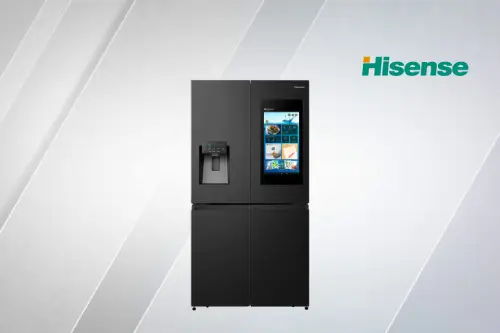
Hisense refrigerators — counter-depth French-door units like the RF20N6ASE and HRF210N6CBE, plus top- and bottom-mount models — run a single sealed compressor system managed by thermistor sensors reporting to the main board. When cooling drifts, the board flags an E-series sensor code rather than pointing at the actual failed part, so we ohm-test each sensor before condemning anything.
Ice and water features on the dispenser models use their own inlet valve, filter, and supply line that can fail while the cooling circuit is fine. On sealed-system faults — a leaking evaporator or a weak compressor — we recover refrigerant under EPA Section 608 before any line is opened.
Common issues we fix:
- Not cooling or weak cooling
- Freezer cold but fresh-food side warm
- E0 / E1 sensor error codes on the display
- Ice maker not producing or dispenser dead
- Frost sheeting on the back panel (defrost fault)
- Compressor running constantly, cabinet still warm
- Door not sealing, condensation at the gasket
Hisense Freezer Repair
Hisense chest and upright freezers share the same sealed-refrigeration logic as its refrigerators, so a unit that runs nonstop but won’t hold temperature usually has a defrost sensor or evaporator airflow problem rather than a dead compressor. We test the defrost circuit and sensor resistance before ordering parts.
Because a standalone Hisense freezer is an inexpensive unit, we’re direct about cost: a manifold-level sealed-system repair may exceed the value of an entry chest freezer, and we’ll say so. Sealed-system work is handled under EPA Section 608, the same certification our refrigeration repairs require.
Common issues we fix:
- Not freezing or weak freezing
- Heavy frost or ice sheets on the walls
- Freezer runs constantly
- Temperature swings between cycles
- Water pooling from a blocked defrost drain
- Lid or door not sealing
Hisense Dishwasher Repair
Hisense dishwashers such as the 24-inch HUI6220XCUS use a circulation pump, a separate drain pump, and a turbidity sensor to manage each cycle. When water is left standing or dishes come out dirty, we test each pump individually and check the filter and drain routing before assuming the control board is at fault.
Leaks usually trace to the door gasket, the sump seal, or a loose hose clamp rather than the tub itself. We find the actual origin so the repair holds instead of reappearing after the next wash.
Common issues we fix:
- Not draining / standing water in the sump
- Leaks from the door or base
- Dishes cloudy or still soiled
- Won’t fill or fills too slowly
- Stops mid-cycle
- Door latch or control panel not responding
Hisense Washer Repair
Hisense washers in front- and top-load formats report faults with a compact set of codes: an E1 when the drum doesn’t reach water level in time, an E2 when it won’t drain within the cycle window, and a dE when the door lock isn’t confirmed. We read the code, then verify the part — testing the inlet valve, drain pump, or door interlock directly.
Top-load models flag UNB on an unbalanced spin; we redistribute, then check the suspension and leveling rather than just clearing the code. Leaks get traced to the pump housing, boot, or hose before any part is quoted.
Common issues we fix:
- E1 fill fault / won’t fill
- E2 drain fault / water left in drum
- Won’t spin or leaves loads soaked
- dE door lock error / door won’t open
- UNB imbalance, excessive walking on spin
- Leaking from the boot or pump
Hisense Dryer Repair
Hisense dryers depend on clean venting and an accurate moisture sensor to finish a cycle efficiently. When loads come out damp or the drum won’t turn, we check heater output, the thermal fuse and cycling thermostat, and the belt-and-roller drive rather than swapping parts by guess.
A partial vent restriction can double cycle time without throwing any warning, so airflow is the first thing we measure. Most Hisense dryer faults are element, fuse, or drive-component failures we can complete in one visit.
Common issues we fix:
- No heat or insufficient heat
- Takes far too long to dry
- Drum won’t tumble
- Stops mid-cycle or won’t start
- Burning smell or overheating
- Loud thump, squeal, or scraping
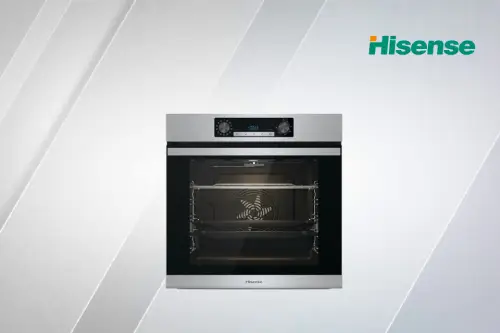
Hisense Oven Repair
Hisense ovens — the oven cavity of ranges like the electric HBE3502CAS — that underbake or won’t reach temperature usually have a failing bake element or a drifting oven temperature sensor. We test element continuity and sensor resistance, then verify the control relay output before replacing anything.
On gas ranges, an oven that won’t light points to the igniter or the safety-valve circuit. We confirm the igniter draws enough current to open the valve rather than assuming the valve itself failed.
Common issues we fix:
- Oven won’t heat or preheats slowly
- Runs too hot or too cold vs. the set point
- Broil element not working
- Uneven baking / convection fan not running
- Door won’t seal or latch
- Display or control panel errors
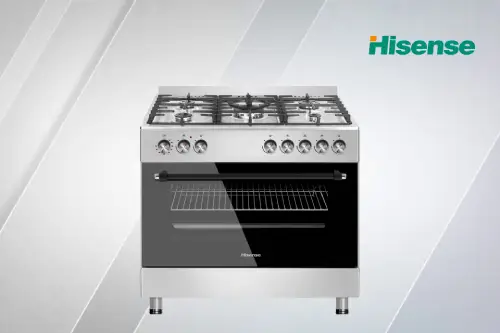
Hisense Stove & Range Repair
Hisense sells full gas and electric ranges rather than separate wall units, so a stove complaint almost always ties back to the cooktop surface, the burners, or the shared control. We inspect elements, igniters, valves, and switches to restore predictable heat.
Electric models can lose a single surface element or an infinite switch; gas models develop weak or clicking igniters. We test the exact circuit at fault before recommending a part, and confirm gas models light and hold flame safely before we leave.
Common issues we fix:
- Surface element not heating (electric)
- Burner won’t ignite or keeps clicking (gas)
- Range won’t power on
- Control knobs loose or unresponsive
- Uneven heat across burners
- Smell of gas or weak flame (gas models)
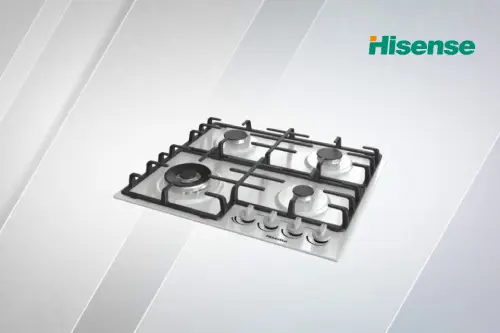
Hisense Cooktop Repair
The cooktop surface on a Hisense range — radiant-glass on electric models, sealed burners on gas — is the part homeowners call about most. Because it shares wiring and controls with the oven below, we test the surface circuits and the shared control together to isolate the true fault.
On radiant-glass tops we check the element and its switch; on gas we test spark and burner gas flow. Cracked glass is assessed for safe use, and we lay out replacement cost honestly on these value-priced units.
Common issues we fix:
- Burner or element won’t heat
- Controls unresponsive
- Uneven or weak heat
- Clicking igniter that won’t stop (gas)
- Cracked glass surface (assessment and options)
- Indicator lights not working
Hisense Refrigerator & Freezer Sensor Codes
Hisense refrigeration boards report faults as E-series sensor codes. Each code points at a temperature or defrost sensor circuit, not directly at the failed part — so we ohm-test the sensor (a healthy thermistor reads roughly 2 kΩ at 25°C / 77°F) and inspect its harness before replacing anything. Hisense assigns these channels slightly differently across model years, so we confirm the exact code against the unit’s service sheet; you can cross-check your model in Hisense’s official product manuals and support library.
| Code | What Hisense flags | How we diagnose it |
|---|---|---|
| dE | Door detected open / door-switch circuit | Check door alignment and gasket; test the door switch for continuity |
| E0 | Ambient (room) temperature sensor open or shorted | Measure sensor resistance against spec; inspect the harness at the main board |
| E1 | Compartment temperature sensor fault | Ohm-test the compartment thermistor; check the connector for corrosion |
| E2 | Cabinet not holding a stable set temperature | Correlate sensor readings with actual box temp; check damper and evaporator fan |
| E3 | Freezer-side temperature sensor fault | Ohm-test the freezer thermistor and verify wiring back to the control |
| E4 | Defrost / evaporator sensor circuit fault | Test the defrost sensor and heater circuit; confirm the defrost cycle initiates |
Hisense Washer Error Codes
Hisense washers use a short, consistent code set for the faults we see most. Have the code ready when you call and we’ll bring the likely part. As with any electronic board, we verify the component the code points to before replacing it.
| Code | Meaning | How we diagnose it |
|---|---|---|
| E1 | Drum did not reach water level in time (fill fault) | Check inlet valve, water supply/pressure, inlet screen, and the level sensor |
| E2 | Water not drained within cycle time (drain fault) | Inspect drain pump, filter, and hose for blockage or kink; test the pump winding |
| dE | Door lock not confirmed | Test the door interlock/latch switch and its harness |
| UNB | Load imbalance on spin (top-load) | Redistribute the load; check suspension, shock absorbers, and leveling |
Hisense Dishwasher, Dryer & Range — Symptom to Diagnosis
Hisense dishwashers, dryers, and ranges vary in how (and whether) they surface a numeric code across model years, so for these we work from the symptom. The table below shows how our technician isolates the fault before quoting a part.
| Symptom | Likely area | How we diagnose it |
|---|---|---|
| Dishwasher won’t drain / standing water | Drain pump, filter, hose | Clear the filter, bench-test the drain pump, check the drain high-loop |
| Dishwasher leaking | Door gasket, sump seal, hoses | Run a dye trace to the source; inspect gasket and sump seals |
| Dryer no heat | Heating element, thermal fuse, thermostat | Test element continuity, fuse, and cycling thermostat; confirm airflow |
| Dryer won’t tumble | Belt, motor, drum rollers | Inspect the belt, test the motor, check roller wear |
| Range oven won’t reach temperature | Bake element/igniter, oven sensor, control | Test element or igniter draw, sensor resistance, and relay output |
| Surface element/burner won’t heat | Element & switch (electric) / igniter & valve (gas) | Test element and infinite switch, or spark igniter and gas-valve safety circuit |
Technician Case Studies — Hisense Repairs

Diagnostic & Resolution: Ohm-tested the ambient temperature sensor — open circuit versus the ~2 kΩ spec at room temp. Replaced the sensor, cleared the code, and confirmed the fresh-food compartment pulled down to 38°F over a two-hour recovery check.
Diagnostic & Resolution: Cleared the filter and bench-tested the drain pump — impeller seized on debris. Replaced the drain pump and verified full drainage in under 90 seconds on two back-to-back cycles.
Diagnostic & Resolution: Pulled the pump filter — blocked by a coin and lint. Cleared the debris, tested the drain pump winding within spec, and ran a rinse-and-spin that drained clean; no E2 recurrence over three cycles.
Diagnostic & Resolution: Tested the bake element — partial continuity with a visible break, and the oven sensor read within spec. Replaced the bake element and verified temperature within ±10°F of the set point using a calibrated thermocouple.
Diagnostic & Resolution: Tested the defrost sensor and heater circuit — sensor out of range and heater not energizing. Replaced the defrost sensor, confirmed a full defrost cycle, and verified airflow restored after the ice cleared.
Frequently Asked Questions — Hisense Appliance Repair
What Hisense appliances do you repair?
My Hisense shows an error code like E0 or E2 — what does it mean?
Is it worth repairing a Hisense appliance or should I replace it?
How fast can you come, and is the repair covered by a warranty?
How much does Hisense appliance repair cost?
Address
Brooklyn, NY 11238
Manhattan, Staten Island
Appliance Repair
Payment Options