 Refrigerator Repair
 Dishwasher Repair
 Washer Repair
 Dryer Repair
 Oven Repair
 Stove/Cooktop Repair
 Freezer Repair
 Appliance Installation
 Samsung
 Bosch
Bosch
 Thermador
 Miele
Miele
 Sub Zero
 Bloomberg
 Asko
Asko













Fulgor Milano Appliance Repair Services
Your Local Fulgor Milano Appliance Repair Company
- Sealed burner won’t ignite / keeps sparking
- Gas burner lights then goes out (safety valve)
- Induction cooktop zone not heating or cutting out
- Oven runs hot or cold, uneven baking
- Convection fan not circulating
- Oven door soft-close or lock failure
- Wall oven control board / touch display fault
- Built-in refrigeration not cooling
- Dishwasher not draining or filling
- Dual-fuel range not reaching set temperature

Article Reviewed & Technically Verified by Dmitry V., Lead EPA-Certified Technician (15+ Years Experience)
Fulgor Milano is an Italian premium cooking brand built by Meneghetti S.p.A., and its pro-style dual-fuel ranges, gas and induction cooktops, and 700 Series wall ovens rely on sealed burner ignition, induction generator boards, and RTD oven sensors that need cooking-specific diagnostics. Brooklyn Appliance Repair NYC provides same-day Fulgor Milano repair across Brooklyn and the surrounding boroughs, with EPA Section 608 certification for its built-in refrigeration line.
Our Happy Customers



- 15+ Years Experience
- Warranty on Parts & Labour
- Gas, Electric & Induction Trained
- EPA 608 Certified Technicians
Our Fulgor Milano Appliance Repair Services
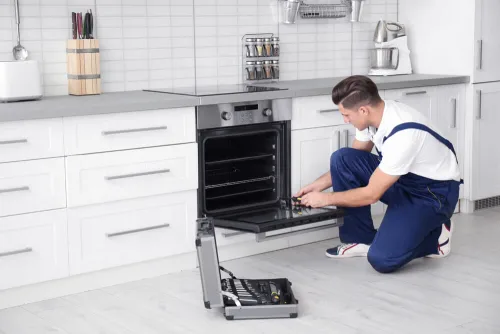
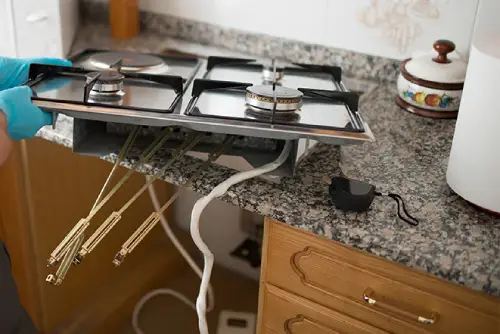
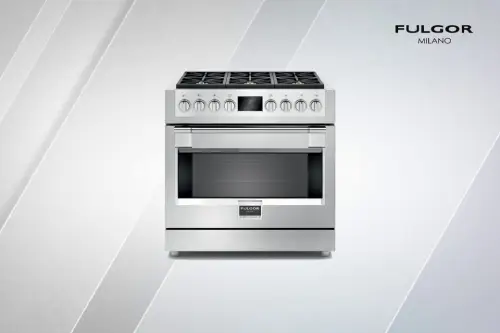
Fulgor Milano Range Repair
Fulgor Milano pro-style ranges — like the Sofia 600 Series F6PDF366S1 and the 48-inch F6PDF486GS1 — pair sealed dual-crescendo gas burners with a convection electric oven, so a fault can sit on either the gas side or the electronic side. We test spark electrodes, the spark module, and the flame-sensing safety valve before touching the oven cavity, and our range and cooktop repair work always confirms which system actually failed.
On dual-fuel models a burner that lights and then dies almost always points to a thermocouple or gas safety valve that isn’t holding, not the igniter. We measure the safety-valve millivolt signal and verify flame contact rather than replacing parts by guesswork.
Common issues we fix:
- Burner won’t light or keeps clicking
- Burner lights then goes out
- Weak, uneven, or yellow flame
- Oven not reaching set temperature
- Control knob or valve stiff / not regulating
- Griddle or center burner not igniting
- Oven runs hot or cold on a dual-fuel range
- Range won’t power on
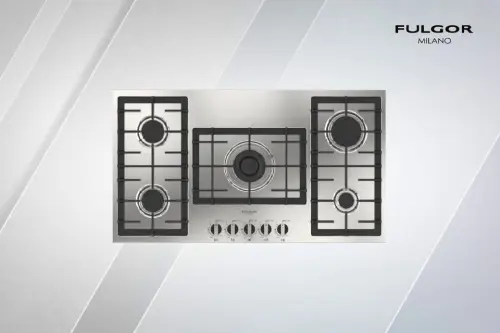
Fulgor Milano Cooktop Repair
Fulgor Milano builds both gas and induction cooktops, and the two fail in completely different ways. On induction models such as the 700 Series F7IT36S1, a zone that heats briefly and then quits usually traces to the induction generator board, the coil, or the cooling fan that protects that board — and our cooktop repair starts by testing pan detection and coil resistance before condemning the board.
Gas cooktops are diagnosed through the ignition path instead: spark electrode, spark module output, and burner-port cleanliness. We verify each element is safe and regulating correctly before we leave.
Common issues we fix:
- Induction zone won’t heat or cuts out mid-use
- Cooktop not detecting cookware
- Gas burner won’t ignite / keeps clicking
- Touch controls unresponsive or erratic
- Cooling fan running loud or constantly
- Cracked glass (assessment and options)
- Uneven heat or weak flame
- Cooktop won’t power on
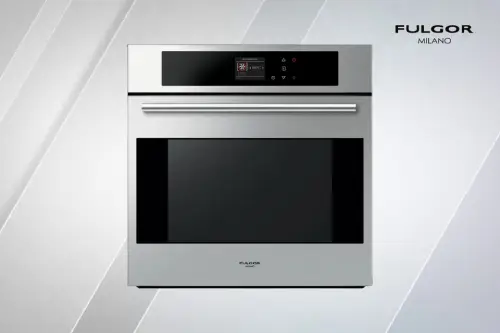
Fulgor Milano Wall Oven Repair
Fulgor Milano 700 Series wall ovens — single units like the F7SP30S1 and double configurations — use dual true convection and an RTD temperature sensor for precise baking. When an oven overbakes, underbakes, or drifts, we compare the RTD sensor’s resistance against its rated curve and check the control-board relay before replacing anything, and our oven repair confirms calibration with an independent thermocouple.
Convection problems and soft-close door faults affect results even when the bake element is fine. We test the convection motor, convection element, and door lock assembly as a system rather than swapping the most obvious part.
Common issues we fix:
- Runs too hot or too cold / uneven baking
- Bake or broil element not heating
- Convection fan not circulating
- Touch display dark or unresponsive
- Door won’t soft-close or won’t lock
- Self-clean cycle faults or door-lock stuck
- Oven light or meat-probe not working
- Oven shuts off mid-bake
Fulgor Milano Refrigeration Repair
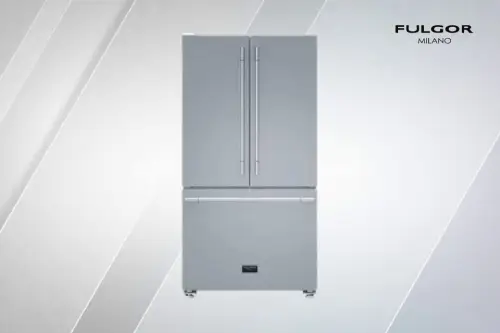
Fulgor Milano’s North American line includes built-in column and French-door refrigeration that runs on a sealed refrigerant system. When one of these units stops holding temperature, we diagnose by component — compressor, condenser fan, evaporator fan, defrost heater, and thermistors — and any work on the sealed system is performed under EPA Section 608 certification.
Built-in units are tightly integrated into custom cabinetry, so a careless repair can damage the surround. We work methodically to trace frost buildup, warm zones, or water leaks to the actual failed part without cosmetic damage.
Common issues we fix:
- Not cooling or weak cooling
- One section warm while another stays cold
- Frost buildup on the evaporator
- Compressor running constantly or cycling
- Water leaking or pooling inside
- Condenser or evaporator fan noise
- Door not sealing, condensation at gasket
- Ice maker not producing (where equipped)
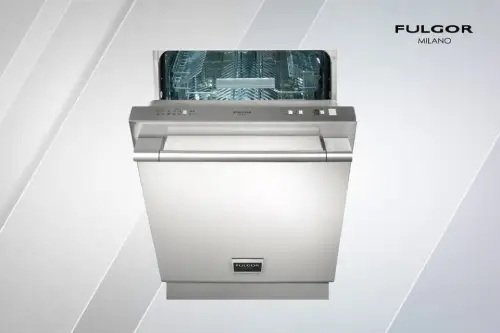
Fulgor Milano Dishwasher Repair
Fulgor Milano’s built-in dishwashers round out the kitchen, and when one stops draining or leaves dishes dirty the fault is usually mechanical. We test the drain pump, circulation pump, inlet valve, and spray-arm delivery individually, and check the door seal before recommending any part.
Standing water and slow fills are traced to the pump, filter, or inlet valve rather than reset by trial and error, so the same problem doesn’t come back a week later.
Common issues we fix:
- Not draining / standing water
- Won’t fill or fills too slowly
- Leaks from door or base
- Dishes come out cloudy or dirty
- No heat / poor drying
- Stops mid-cycle
- Spray arms not spinning
- Door latch or control issues
How We Diagnose Fulgor Milano Faults
Fulgor Milano’s premium cooking appliances do not publish a broad consumer error-code list — per Fulgor Milano’s official 700 Series use-and-care documentation, the control simply blocks the current function and logs a generic fault when a sensor or circuit reads out of range. Because there is no reliable code dictionary to lean on, we diagnose by symptom and component. The tables below show how our technicians isolate the actual fault before quoting any parts.
Fulgor Milano Range & Cooktop — Symptom to Diagnosis
| Symptom | How We Diagnose |
|---|---|
| Burner won’t light / keeps sparking | Test spark electrode gap and igniter module output; check for a wet or cracked electrode and blocked burner ports before condemning the module. |
| Burner lights then goes out | Measure the thermocouple / flame-sensing safety-valve millivolt signal and verify flame contact; a weak signal keeps the valve from latching open. |
| Induction zone won’t heat / cuts out | Confirm pan detection, test induction coil resistance and the generator (inverter) board, and verify the cooling fan that protects the board is running. |
| Weak or uneven flame | Inspect burner ports and orifice for debris, verify regulator pressure, and confirm the burner cap is seated correctly. |
Fulgor Milano Wall Oven & Range Oven — Symptom to Diagnosis
| Symptom | How We Diagnose |
|---|---|
| Runs hot/cold, uneven bake | Measure the RTD oven temperature sensor’s resistance against its rated curve; a drifting sensor sends the wrong signal to the control and skews the whole cavity. |
| Bake or broil element not heating | Test element continuity and check the corresponding relay on the control board for a stuck or open contact. |
| Convection not circulating | Test the convection fan motor and convection element separately; a failed motor stalls airflow while a failed element cools the bake. |
| Door won’t lock / self-clean fault | Check the door-lock motor and switch feedback so the control confirms a locked door before running a clean cycle. |
| Display dark / no power | Verify incoming supply, harness connections, and control-board power rails before replacing the board. |
Fulgor Milano Built-In Refrigeration — Symptom to Diagnosis
| Symptom | How We Diagnose |
|---|---|
| Not cooling | Check compressor operation and sealed-system pressures under EPA Section 608, then verify condenser fan and airflow before assuming a refrigerant fault. |
| Warm zones / uneven temps | Test the evaporator fan, air damper, and thermistor readings that route cold air between compartments. |
| Frost buildup on evaporator | Test the defrost heater and defrost thermostat and confirm the control is calling for defrost cycles. |
| Water leak or pooling | Trace the supply valve and drain path; a clogged defrost drain or failing valve is the usual source, not the sealed system. |
For dishwashers we work the same way — drain pump and filter for standing water, inlet valve and float for fill faults, circulation pump and spray arms for poor cleaning. Call us with the exact symptom and we’ll arrive with the parts most likely to resolve it.
Technician Case Studies — Fulgor Milano Repairs

Diagnostic & Resolution: Found spark electrode cracked at the ceramic base, arcing to the burner cap instead of the gas. Replaced the electrode and cleaned carbon from the burner ports; all four burners confirmed a clean single-click light with a steady blue flame.
Diagnostic & Resolution: RTD oven sensor read out of tolerance against its rated resistance curve at room temperature. Replaced the sensor and verified the cavity held within a few degrees of set point using an independent thermocouple across a full preheat.
Diagnostic & Resolution: Cooling fan for the generator board was seized with dust, causing the board to over-temp and drop the zone as a protection. Cleaned and replaced the fan, confirmed coil resistance and pan detection in spec; zone held full output through a boil test.
Diagnostic & Resolution: Flame-sensing safety valve reading a low millivolt signal — the thermocouple tip had drifted out of the flame path. Repositioned and replaced the sensor; the oven burner latched and held through a two-hour bake with no drop-out.
Diagnostic & Resolution: Condenser fan motor had failed, so the sealed system couldn’t reject heat. Sealed-system pressures were verified normal under EPA 608. Replaced the condenser fan; the column pulled back down to temperature and cycling returned to normal.
Diagnostic & Resolution: Drain pump impeller was jammed with a shard of glass; the filter had a matching crack letting debris through. Cleared the impeller, replaced the filter, and confirmed full drainage in under a minute across two back-to-back cycles.
Frequently Asked Questions — Fulgor Milano Appliance Repair
What Fulgor Milano appliances do you repair?
Does Fulgor Milano use error codes I can look up?
Do you service gas, induction, and dual-fuel Fulgor Milano models?
What Fulgor Milano problems do you fix most often?
How much does Fulgor Milano appliance repair cost?
Address
Brooklyn, NY 11238
Manhattan, Staten Island
Appliance Repair
Payment Options