 Refrigerator Repair
 Dishwasher Repair
 Washer Repair
 Dryer Repair
 Oven Repair
 Stove/Cooktop Repair
 Freezer Repair
 Appliance Installation
 Samsung
 Bosch
Bosch
 Thermador
 Miele
Miele
 Sub Zero
 Bloomberg
 Asko
Asko












Forno Appliance Repair Services
Your Local Forno Appliance Repair Company
- Forno range burner won’t light
- Forno igniter clicking non-stop
- Forno oven not holding temperature
- Forno dual-fuel oven baking unevenly
- Forno convection fan noise
- Forno oven door seal worn
- Forno French-door fridge not cooling
- Forno refrigerator ice maker not producing
- Forno dishwasher not draining
- Forno range hood weak extraction

Article Reviewed & Technically Verified by Dmitry V., Lead EPA-Certified Technician (15+ Years Experience)
Forno builds Italian-styled, pro-style kitchen appliances — sealed-brass-burner ranges, rangetops and cooktops, wall ovens, French-door refrigerators, dishwashers, and range hoods — at value pricing. Brooklyn Appliance Repair NYC diagnoses and repairs gas, dual-fuel, and electric Forno units the same day across Brooklyn and nearby neighborhoods, using safe, code-correct testing on every service call.
Forno (Forno Appliances) is a value-focused brand that brings a commercial, Italian-inspired look to the home kitchen without a commercial price tag. Its lineup centers on cooking and refrigeration — pro-style ranges, rangetops, wall ovens, range hoods, French-door and built-in refrigerators, and dishwashers — rather than laundry. Because these are relatively new units built around genuine gas, dual-fuel, and sealed-system components, they respond best to a technician who diagnoses the actual failure instead of swapping parts by guesswork.
Our Happy Customers
- 15+ Years Experience
- Warranty on Parts & Labour
- 100% client satisfaction
- Skilled Technicians
Our Forno Appliance Repair Services
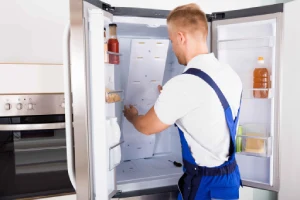
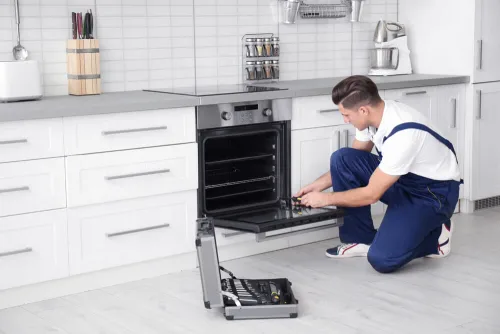
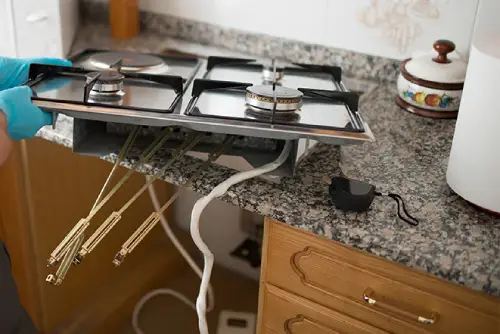
Forno Refrigerator Repair
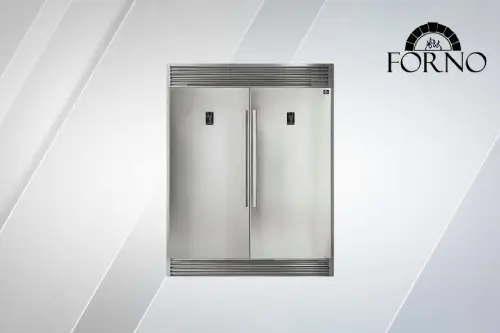
Forno’s Alta Qualita French-door and Salerno side-by-side refrigerators are counter-depth, forced-air units controlled by electronic sensors rather than a mechanical cold-control dial. When one section drifts warm while the other stays cold, the cause is usually airflow or defrost, not a low charge — so we read the evaporator and defrost thermistors, check the defrost heater, and watch the condenser and evaporator fans before touching the sealed system.
Sealed-system work on a Forno fridge requires EPA Section 608 certification because it involves recovering and recharging refrigerant. We only open the sealed circuit after ruling out gaskets, fan motors, and control faults, so you aren’t paying for a compressor job the appliance didn’t need.
Common issues we fix:
- Fresh-food section warm, freezer still cold
- Ice maker not producing or overfilling
- Water pooling under crisper drawers or on the floor
- Condenser or evaporator fan noise
- Frost buildup on the back panel
- Door not sealing, gasket condensation
Forno Range Repair
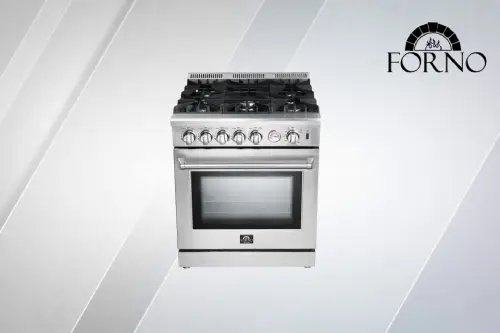
Forno pro-style ranges such as the Galiano and Capriasca use Italian DEFENDI sealed brass burners over a cast-iron grate, and most are dual-fuel — a gas cooktop paired with an electric convection oven. That split is the key to diagnosing them: a burner that won’t stay lit points to the spark igniter, burner cap alignment, or the flame-safety circuit, while an oven that under-bakes points to the electric bake element, temperature sensor, or control board. We test each side on its own during a range and stove repair rather than assuming one fault explains both.
On gas models we verify the igniter draws enough current to open the safety valve and check burner ports for obstruction. On the oven side we confirm element continuity and compare the sensor reading against a calibrated thermocouple before calling any part bad.
Common issues we fix:
- Burner won’t light or igniter keeps clicking
- Weak or uneven flame on one burner
- Oven slow to preheat or won’t hold temperature
- Convection fan not circulating or noisy
- Oven door won’t seal, heat escaping
- Control display unresponsive
Forno Cooktop & Rangetop Repair
Forno gas rangetops and electric cooktops share components with the ranges but fail in their own ways. On a gas rangetop, a single burner that won’t light while the others do usually isolates to that burner’s igniter electrode or a clogged port — not the whole spark module. On an electric or glass cooktop, a dead zone is more often a failed element or a cracked solder joint at the switch than a control-board fault. We confirm the specific circuit during every cooktop and rangetop repair before quoting a part.
Cracked glass and unresponsive touch controls are assessed for safe operation first — a compromised surface over a live element isn’t something to keep using while parts are ordered.
Common issues we fix:
- One burner or zone won’t heat
- Igniter clicking with no flame
- Uneven or weak heat output
- Touch controls unresponsive
- Cracked glass surface (assessment and options)
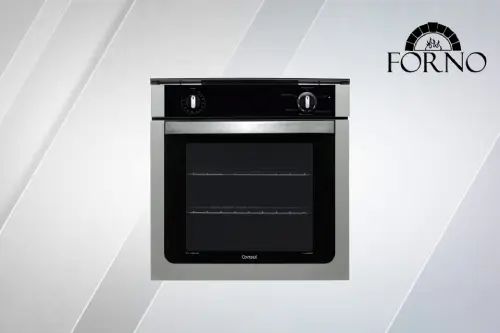
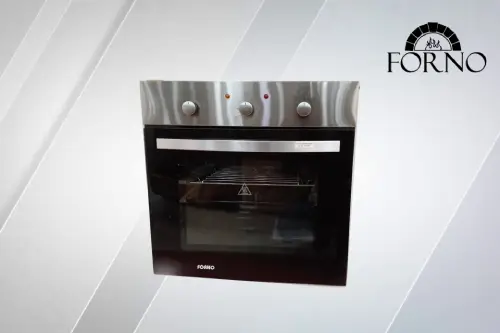
Forno Wall Oven Repair
Forno electric wall ovens rely on a bake element, a broil element, a temperature sensor, and a control board working together to hold a set point. When an oven runs hot, runs cold, or shuts off mid-bake, we don’t replace parts by elimination — we measure element continuity, read the sensor’s resistance against temperature, and verify actual cavity temperature with a thermocouple. That’s the difference between a lasting oven repair and a repeat visit.
Convection-fan failure and a worn door gasket both skew baking results even when the elements test fine, so we inspect the full heat path, not just the most obvious component.
Common issues we fix:
- Not heating or slow to preheat
- Runs too hot or too cold vs. the set point
- Broil element not working
- Convection fan not running
- Door won’t close or seal properly
- Oven shuts off mid-cycle
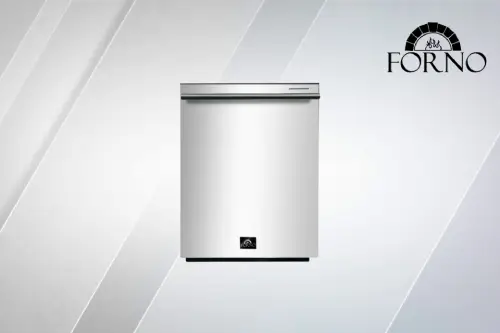
Forno Dishwasher Repair
Forno’s Alta Qualita 24" pro-style built-in dishwashers depend on a circulation pump, a drain pump, spray-arm delivery, and a fine filter to clean well. Standing water almost always traces to the drain pump or a clogged filter, while cloudy dishes point to circulation or heating. We test each pump on its own and check the spray arms for free rotation before recommending any replacement.
Door-latch and gasket faults are the other frequent culprit — a latch that doesn’t register as closed will stop a cycle before it starts, and we verify the switch rather than assuming a control problem.
Common issues we fix:
- Won’t drain / standing water in the tub
- Dishes come out cloudy or gritty
- Leaks from the door or base
- Won’t start or stops mid-cycle
- Spray arms not spinning
- Door latch or control faults
Forno Range Hood Repair
Forno wall-mount, under-cabinet, and island range hoods move air with a blower motor pulling through baffle filters. Weak extraction is usually grease-loaded baffles or a failing blower capacitor, not a duct problem, so we test the motor and capacitor and inspect the filters before assuming the ductwork is at fault. Non-working lights and unresponsive control pads are traced to the switch harness and board.
Common issues we fix:
- Weak or no extraction at any speed
- Blower loud, rattling, or vibrating
- Fan won’t change speeds
- Lights not working
- Controls unresponsive
How We Diagnose Forno Faults
Forno is a newer, value-priced pro-style brand, and it does not publish a universal error-code chart the way legacy manufacturers do — codes shown on any given model are cross-referenced against that model’s own use-and-care guide in Forno’s official product support library. Rather than reprint codes that may not apply to your unit, we work from symptoms. The tables below show how our technicians move from what you see to the actual component at fault. Have your model number ready when you call for the fastest estimate.
Forno Range & Oven — Symptom to Diagnosis
| Symptom | How We Diagnose It |
|---|---|
| Burner won’t light, igniter keeps clicking | Check burner cap seating and port obstruction, then test the spark electrode and igniter module current at the affected burner. |
| Burner lights then goes out | Test the flame-safety circuit (thermocouple/flame sensor) and gas-valve solenoid holding the burner open. |
| Oven won’t hold or reach temperature | Measure bake-element continuity and read the oven temperature sensor against a calibrated thermocouple in the cavity. |
| Baking uneven despite correct set point | Verify convection-fan operation and inspect the door gasket seal, since either skews heat distribution. |
| Display dark or controls unresponsive | Confirm incoming power and check the control-board harness connections before condemning the board. |
Forno Refrigerator — Symptom to Diagnosis
| Symptom | How We Diagnose It |
|---|---|
| Fresh-food warm, freezer still cold | Check the evaporator fan and damper airflow to the fresh-food section before suspecting the sealed system. |
| Whole unit warm, compressor runs | Inspect condenser coils and condenser-fan operation; confirm a sealed-system loss only with EPA 608 gauges. |
| Heavy frost on the back panel | Test the defrost heater and defrost thermistor to confirm the defrost cycle is completing. |
| Ice maker not producing | Test the water inlet valve solenoid for continuity and verify fill volume and freeze cycle. |
| Water pooling inside or on the floor | Trace to a clogged defrost drain or a supply/inlet leak before replacing any part. |
Technician Case Studies — Forno Repairs

Diagnostic & Resolution: Measured bake-element continuity — open circuit, no continuity end to end. Replaced the bake element and confirmed the cavity held within a few degrees of the set point using a calibrated thermocouple across a full preheat cycle. Gas cooktop verified unaffected.
Diagnostic & Resolution: Isolated the fill circuit — water inlet valve solenoid showed no continuity. Replaced the inlet valve, confirmed correct fill volume and a completed freeze/harvest cycle before leaving. No sealed-system work required.
Diagnostic & Resolution: Found the burner cap misaligned and the port partially blocked from spill-over. Cleared and reseated the cap, tested the spark electrode and confirmed the igniter module fired all burners cleanly with steady flame on the affected head. No parts required.
Diagnostic & Resolution: Removed the sump filter and drain-pump cover — impeller obstructed by debris. Cleared the pump, verified free impeller rotation, and confirmed the tub drained fully within the normal drain window across two back-to-back cycles. No parts replaced.
Diagnostic & Resolution: Condenser coils were packed with dust and the condenser fan had seized. Cleaned the coils and replaced the condenser fan motor; verified restored airflow and confirmed both compartments pulled back down to spec over a monitored cool-down. Sealed system intact.
Frequently Asked Questions — Forno Appliance Repair
What Forno appliances do you repair?
How quickly can you repair my Forno appliance?
Is there a warranty on Forno repairs?
What Forno problems do you fix most often?
How much does Forno appliance repair cost?
Address
Brooklyn, NY 11238
Manhattan, Staten Island
Appliance Repair
Payment Options