 Refrigerator Repair
 Dishwasher Repair
 Washer Repair
 Dryer Repair
 Oven Repair
 Stove/Cooktop Repair
 Freezer Repair
 Appliance Installation
 Samsung
 Bosch
Bosch
 Thermador
 Miele
Miele
 Sub Zero
 Bloomberg
 Asko
Asko














Cavavin Appliance Repair Services
Your Local Cavavin Wine Cellar & Cooler Repair Company
- Wine cooler not cooling or not holding temperature
- Dual-zone temperature imbalance
- Compressor start relay or overload failure
- Thermoelectric (Peltier) module not cooling
- Condenser or evaporator fan noise
- Condensation and humidity buildup inside the cabinet
- Control panel or LED display unresponsive
- Door seal or UV-tinted glass not sealing
- Unit runs constantly but stays warm
- Excessive vibration disturbing wine sediment


Article Reviewed & Technically Verified by Dmitry V., Lead EPA-Certified Technician (15+ Years Experience)
Cavavin is a Canadian wine-refrigeration specialist, and its cellars and coolers cool one of two ways — a compressor-based sealed system or a thermoelectric (Peltier) module — so an accurate repair starts by identifying which one your unit uses. Brooklyn Appliance Repair NYC provides same-day, EPA Section 608-certified diagnostics for Cavavin Vinoa, Urbania, and Classic wine coolers across Brooklyn and the surrounding boroughs.
A failing Cavavin unit puts a collection you have built over years at risk. We arrive with the meters and refrigeration tools the job actually needs, confirm whether the fault is in the cooling system, the fans, the door seal, or the control board, and repair the real cause instead of guessing.
Our Happy Customers






- 15+ Years Experience
- Warranty on Parts & Labour
- 100% client satisfaction
- EPA Section 608-Certified Technicians
Our Cavavin Repair Services
Cavavin Wine Cooler Repair
Cavavin freestanding coolers in the Vinoa (V-series) line hold a tight temperature band that protects your wine, so even a few degrees of drift means something specific has failed. We measure cabinet temperature against the set point, then trace the fault to the compressor circuit, the thermoelectric module, the fans, or a leaking door seal before quoting anything. General refrigeration repair logic applies, but wine units get diagnosed as the precision cooling appliances they are.
Because a Cavavin cooler may cool by compressor or by Peltier module depending on the model and capacity, the first step is always confirming which system is inside — the two fail, and are repaired, in completely different ways.
Common issues we fix:
- Not cooling or drifting above the set temperature
- Runs constantly but never reaches target temp
- Fan buzzing, rattling, or clicking
- Condensation or excess humidity inside the cabinet
- LED display or touch panel unresponsive
- Door not sealing, UV-tinted glass fogging
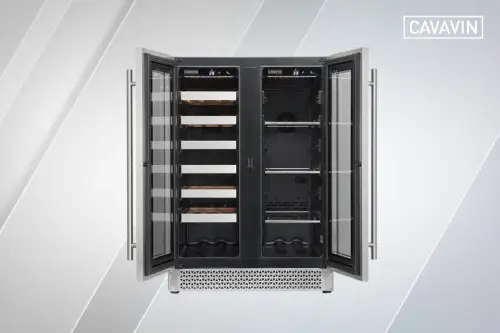
Cavavin Wine Cellar Repair
Larger Cavavin cellars — the Classic C-series and higher-capacity units — run compressor sealed systems and are meant to hold dozens of bottles at a stable temperature and humidity for long-term aging. When cooling weakens, we check the condenser coil and fan first, then the compressor start relay and overload, and only open the sealed system when the readings point there.
Sealed-system work on any Cavavin cellar requires EPA Section 608 refrigerant recovery, which our technicians are certified to perform. We verify the diagnosis with a manifold gauge set rather than replacing a compressor on a hunch.
Common issues we fix:
- Weak cooling or temperature slowly climbing
- Compressor clicking on and off (start relay / overload)
- Condenser fan noisy or stalled
- Frost or ice forming on the rear inner wall
- Humidity too high or too low for aging
- Vibration transmitting into the bottle racks
Cavavin Beverage Center Repair
Cavavin beverage centers such as the C-73WBVC store cans and bottles at cooler-than-wine temperatures and cycle their doors far more often, which wears door seals and fan motors faster. We test the fan circulation, the thermostat or thermistor, and the gasket seal so the unit holds temperature through frequent openings.
These units share the compressor and control architecture of Cavavin's wine refrigeration lineup, so the same diagnostic discipline applies — we confirm the failed component before replacing it.
Common issues we fix:
- Not holding temperature after frequent door use
- Warm at the top, cold at the bottom
- Interior fan noisy or not running
- Water pooling in the base
- Interior light or display out
- Door seal worn from heavy cycling
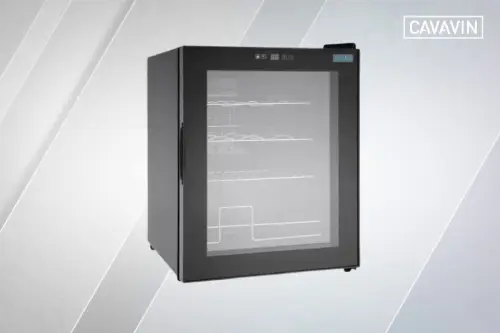
Cavavin Dual-Zone Repair
Dual-zone Cavavin models (the WDZ suffix, such as the Vinoa V-024WDZFG) keep two independent temperature bands so reds and whites can share one cabinet. When one zone drifts while the other stays correct, the fault is almost always local to that zone — a thermistor, an evaporator fan, or a damper — not the whole cooling system.
We test each zone thermistor against its resistance spec and confirm airflow to each compartment, so both bands hold their set points after the repair rather than one being sacrificed for the other.
Common issues we fix:
- One zone warm while the other stays correct
- Both zones drifting to the same temperature
- Zone display reading incorrectly
- Evaporator fan for one zone stalled
- Damper stuck open or closed
- Control board not driving one zone
Cavavin Built-In & Integrated Unit Repair
Built-in Cavavin units in the Urbania line (for example the CAVA46-1NDZ) are designed for zero-clearance, front-venting installation under a counter or flush in cabinetry. That front-vent design makes condenser airflow and heat rejection the first things we check, because a restricted vent path shows up as a unit that runs constantly and never quite cools.
We service integrated Cavavin units in place wherever the enclosure allows, checking the front intake and exhaust, the condenser fan, and the door seal against the cabinet face before touching the sealed system.
Common issues we fix:
- Runs non-stop after being built in (blocked vent path)
- Overheating condenser or hot cabinet exterior
- Not reaching set temperature in an enclosed install
- Front-vent fan noisy or failed
- Door misaligned with the cabinet face
- Control panel or lighting failure
How We Diagnose Cavavin Wine Coolers
Most Cavavin wine coolers do not display consumer error codes, so an accurate repair depends on measured diagnostics rather than reading a code off the panel. The starting point is always the same question: is this a compressor unit or a thermoelectric unit? The two tables below show how our technicians work each symptom. Model-specific placement, venting, and capacity details can be confirmed against Cavavin's official product support documentation.
Compressor-Cooled Cavavin Units — Symptom & Diagnosis
| Symptom | How We Diagnose It |
|---|---|
| Not cooling at all | Test the compressor start relay and overload (PTC) and measure compressor winding resistance; if windings are in spec but the sealed system shows no cooling, we check for refrigerant loss under EPA Section 608 recovery. |
| Runs constantly but stays warm | Inspect the condenser coil for dust, verify the condenser fan motor is spinning at speed, and check the door gasket and unit placement for heat load. |
| Loud hum, rattle, or vibration | Isolate the source between the compressor mounts, condenser fan blade, and any tubing contact; confirm the anti-vibration feet and rack mounts are intact. |
| One zone warm (dual-zone) | Measure the affected zone thermistor against its resistance spec and confirm the evaporator fan and damper are delivering air to that compartment. |
| Water or condensation pooling | Clear the evaporator drain channel, inspect the door seal for a leak path, and check whether high interior humidity is coming from a worn gasket. |
| Display dark or frozen | Check the power supply board, ribbon connector, and membrane touch panel for continuity before replacing the control assembly. |
Thermoelectric (Peltier) Cavavin Units — Symptom & Diagnosis
| Symptom | How We Diagnose It |
|---|---|
| Not cooling, fans running | Measure current draw at the thermoelectric (Peltier) module; a module reading near zero is open and no longer pumping heat. Verify DC power-supply output first. |
| Cools weakly / warm at top | Confirm the cold-side fan is circulating cabinet air and that the module is seated tight against the heat sink with intact thermal paste. |
| Buzzing or fan noise | Inspect the hot-side heat-sink fan and cold-side fan bearings for wear or obstruction; these small fans are the most common noise source on Peltier units. |
| Condensation inside | Check the door seal and note ambient temperature — thermoelectric units are ambient-sensitive and struggle when the room runs hot, which reads as condensation and weak cooling. |
| Panel unresponsive | Test the control board, the temperature thermistor, and the membrane panel for continuity before condemning the electronics. |
Technician Case Studies — Cavavin Repairs

Diagnostic & Resolution: Measured the upper-zone thermistor — reading out of range against spec — and found the upper evaporator fan turning slowly. Replaced the thermistor and the evaporator fan motor; both zones confirmed holding their independent set points over a two-hour soak test.
Diagnostic & Resolution: Tested the compressor start relay and overload — PTC start relay failed open while compressor windings measured within spec. Replaced the start relay; the compressor started and held on the first cycle and the cabinet returned to set temperature. No sealed-system entry required.
Diagnostic & Resolution: Confirmed DC supply voltage was present, then measured current draw at the thermoelectric module — near zero, indicating an open Peltier element. Replaced the thermoelectric module and re-applied thermal paste to the heat sink; cold-side output restored and cabinet pulled down to set temp.
Diagnostic & Resolution: Traced the noise to the condenser fan — blade contacting the shroud and a worn motor bearing. Replaced the condenser fan motor and re-seated the shroud; noise eliminated and airflow across the condenser restored to normal.
Diagnostic & Resolution: Found the evaporator drain channel clogged and a hairline tear in the door gasket at the hinge side. Cleared the drain path and replaced the door gasket; interior humidity normalized and no further pooling on a follow-up cycle.
Diagnostic & Resolution: Condenser coil was packed with dust and the condenser fan was turning weakly. Cleaned the coil and replaced the condenser fan motor; the unit reached set temperature and cycled normally instead of running continuously.
Frequently Asked Questions — Cavavin Appliance Repair
What Cavavin appliances do you repair?
My Cavavin wine cooler stopped cooling — is it the compressor or a thermoelectric problem?
Why is one zone warmer than the other on my dual-zone Cavavin?
Is there a warranty on Cavavin repairs?
How much does Cavavin wine cooler repair cost?
Address
Brooklyn, NY 11238
Manhattan, Staten Island
Appliance Repair
Payment Options